
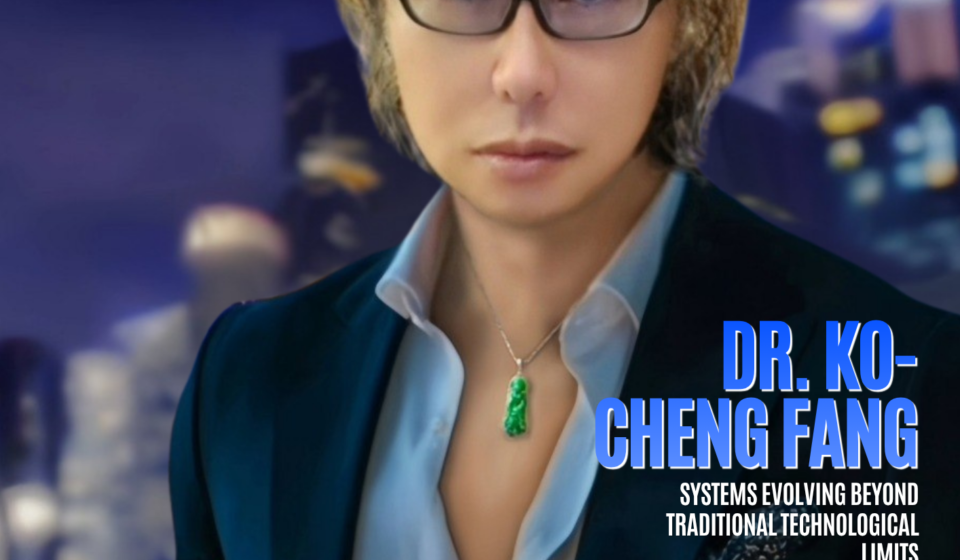

For decades, the story of computing has been written in silicon. It gave us the PC, the smartphone, and the current AI boom. But every material has its breaking point. As transistors shrink below two nanometers, we’re bumping up against the brutal realities of thermodynamics: heat, power, and sheer engineering complexity.
For Dr. Ko-Cheng Fang, the founder and CEO of LongServing Technology, the solution isn’t to squeeze more performance out of a dying architecture—it’s to abandon electrons altogether. His vision? A world where information travels on beams of light.The Photonic Pivot
The core of LongServing’s pitch is “photonic computing.” Rather than pushing electrons through silicon circuits—which generates massive amounts of heat—the company wants to use photons. They’re faster, cooler, and, in theory, ready for the high-octane demands of next-gen AI.

The company just hit a major milestone with its “X-Photon” material. The big engineering hurdle with photonics has always been guidance: How do you force light to turn corners at a nanoscale level without killing the signal?.
According to LongServing, X-Photon is the answer. It’s an optical medium that uses a clever, layered structure—Dr. Fang compares it to how a mirror reflects light—to allow photons to make sharp 90-degree turns while staying inside the circuit. They’ve successfully fabricated 10-nanometer circuits, bringing them one step closer to moving from the lab to a real-world processor.Why This Matters
The numbers LongServing is throwing around are staggering. If they can pull this off, they are aiming for performance gains of up to 1,000 times that of current electronics, while slashing energy consumption by as much as 90 percent.
It’s an aggressive goal, but they’ve got the war chest to back it up. The company recently disclosed a $500 million financing round, putting their valuation at a cool $2.5 billion. The roadmap isn’t just about chips—they’re looking at building future “Photonic Cloud Computing Centres” designed specifically for the heavy lifting of AI.The Road Ahead
Dr. Fang hasn’t just been focused on the hardware; he’s also prepping the ecosystem. He’s introduced a “Strategic Equity Hedging Protocol” to court partnerships with global tech giants, ensuring they aren’t building in a vacuum.

Dr. Ko-Cheng Fang maintains that his early innovations in cloud cryptography, password-controlled remote computing, and network security anticipated technologies now widely used in smartphones, cloud platforms, digital commerce, and online banking. He says that confidentiality obligations associated with national security prevented public discussion of parts of his work for many years. Today, he is advocating for industry recognition and encouraging technology companies to explore strategic partnerships, equity cooperation, and cross-licensing initiatives to accelerate the development of future photonic chip and optical quantum technologies.
Is this the end of the silicon era? It’s too early to say. The engineering and commercial hurdles ahead are massive. But the shift is undeniable: we are seeing a movement toward a future where light is no longer just how we communicate but how we compute. And if LongServing Technology gets its way, the next chapter of computing won’t be written on a silicon wafer—it will be written in light.
Contact Information
Dr. Ko-Cheng Fang
Founder, CEO & Chairman
LongServing Technology Co., Ltd.
Email: service@longserving.com.tw
Website: https://longserving.com.tw/en/
Instagram: @ko_cheng_fang